
Introducing Openora: An Open AI-Native iGaming Framework
.jpg)
We’re excited to introduce something we have wanted to launch for a long time: Openora, an open-source, Ai-native igaming framework, built from the ground up by the Blurify team.
It is an open, modular framework designed to help iGaming operators build new capabilities, modernize existing systems and migrate at their own pace. Openora provides a headless backend with core iGaming domains, a typed API and a plugin-based extension model. It gives technical teams control over the frontend, integrations and custom business logic. To support AI-assisted development, every module is AI-readable, while an MCP development server helps engineers and AI agents understand and extend the platform.
Openora is not another closed, all-in-one platform. Its open-source core can be inspected, extended and integrated into your product stack, keeping your business logic under your control rather than locked into a vendor-controlled system.
We built Openora for one main reason. After years of working with iGaming businesses across different markets and jurisdictions, we kept seeing the same problem: operators wanted to move faster, but their platforms could not evolve at the same speed as their businesses.
We believe there should be a better way forward.
Key takeaways
- Openora is an open-source, modular and AI-native iGaming framework designed for businesses and technical leaders who want to move faster, reduce platform dependency and gain greater control over how their technology evolves.
- It provides a typed backend foundation while leaving the frontend, provider selection and business-specific extensions in your team’s control.
- It helps technical teams build new capabilities, modernize selected parts of their platforms and migrate gradually - without replacing the entire technology stack.
- Modular services and capabilities can be introduced alongside existing systems, allowing teams to start with the business problem that matters most.
- AI-assisted development is part of its architecture from day one, while MCP and clearly defined platform interfaces create a foundation for more advanced AI-powered workflows.
- Our goal is simple: to give gaming businesses the freedom to build, modernize and evolve on their own terms.
The pattern we could no longer ignore
We have been building software products for more than a decade. Over the last years, a significant part of our work has focused on iGaming platforms and custom products for operators.
The market keeps changing. New technologies, business models and regulatory requirements continue to reshape the industry. But the core challenge for operators actually remains the same: the need to move faster than their platforms often allow.
That often means:
- introducing new products,
- improving player experiences,
- entering new markets,
- experimenting with new business models.
Technical teams usually knew what needed to be built. The difficulty was making it happen within the constraints of the existing platform.
Sometimes the operator depended on a vendor’s roadmap and delivery capacity. Sometimes a tightly coupled legacy system made every change more complex than expected. In other cases, the team had inherited technology that very few people fully understood.
The pattern was clear: business ambitions were moving faster than the platforms supporting them.
For many operators, this leaves two options: accept the limitations of the current platform or take on a costly and disruptive replatforming project.
We believe there should be a third.
AI-native by design. Built to be extended and owned
Openora is not a traditional iGaming framework with AI added on top. It is designed from the ground up for a world in which AI agents work alongside engineering teams to build, maintain and evolve software.
The repository includes configured instructions, rules and task-specific skills for coding agents such as Claude, Codex and GitHub Copilot. These configurations give agents the context they need to work consistently across the codebase - whether they are implementing a new feature, modifying existing functionality or working across multiple domains.
Each module also includes its own AGENTS.md file, providing more specific context about its purpose, structure, boundaries and development conventions. This helps agents understand not only how the platform works as a whole, but also how to make changes within an individual domain.
The MCP development server exposes the platform’s routes, schemas, events and integration points in a machine-readable form. This allows agents to explore the system and understand its available capabilities without first navigating the entire source code manually.
Structured scaffold commands support tasks such as:
- creating a new module,
- adding an API route,
- proposing a database change.
Together, these elements give engineers and AI agents clearer context and a structured way to work with the codebase.
The goal is not to replace engineering judgment. It is to reduce repetitive work and help technical teams evolve the platform more efficiently.
AI-readiness is only one part of the framework. Openora is also designed to give teams greater flexibility and control over how their platform evolves.
A headless backend
Openora does not ship with a predefined user interface. The backend handles platform state and business logic - including player sessions, wallet operations, game rounds and compliance rules - and exposes them through a typed API.
Frontend teams can connect through the React SDK and build the experience that fits their brand, market and audience. One backend can therefore support very different products without forcing them into the same interface.
This matters because iGaming products can look very different across jurisdictions, brands and player segments. The same backend foundation can support a mobile-first sportsbook, a premium casino or an entirely new gaming concept. And it all without forcing them into the same interface or customer journey.
Core iGaming domains included
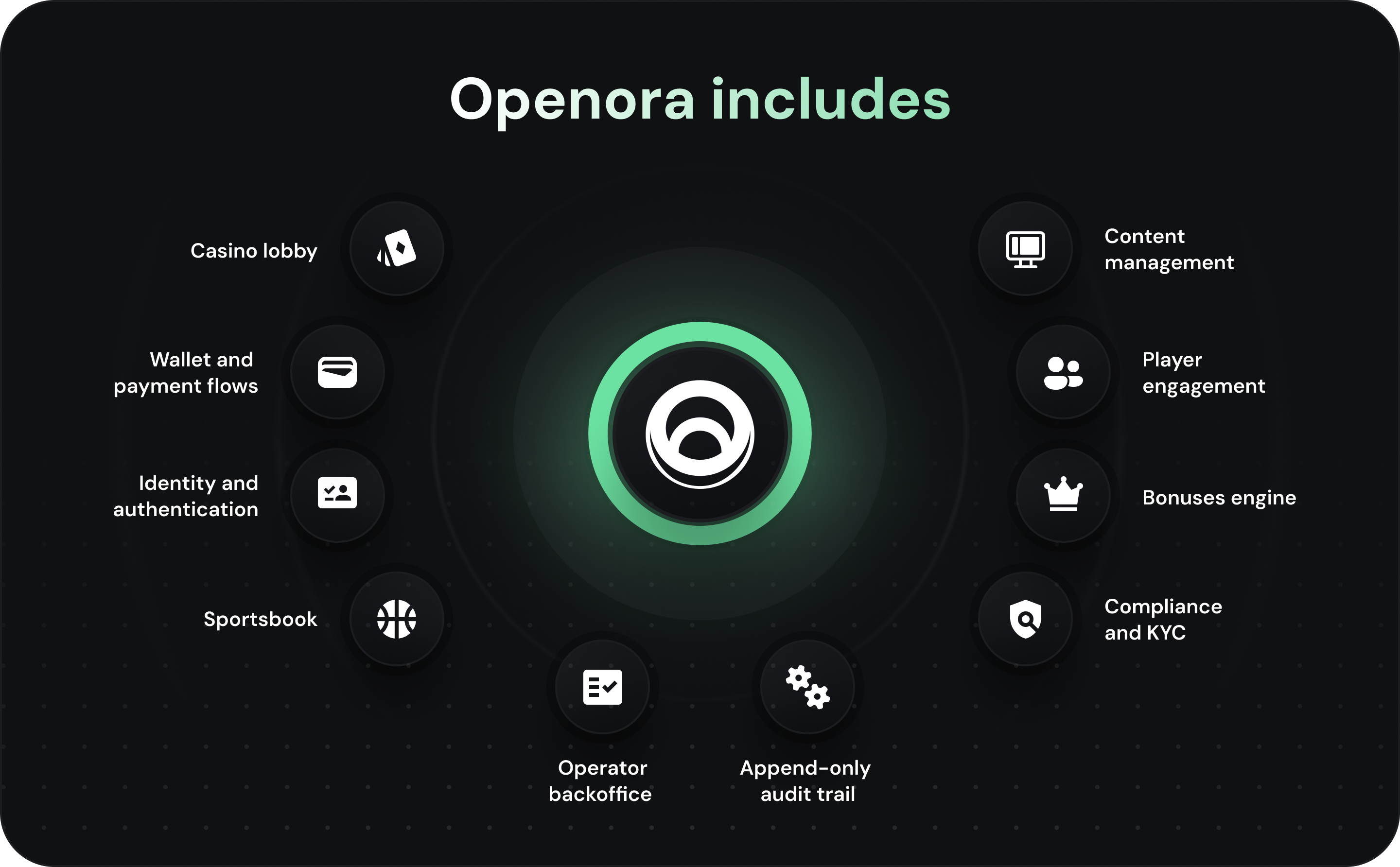
Openora comes with ten integrated domains covering:
- identity and authentication,
- wallet and payment flows,
- casino,
- sportsbook,
- player engagement,
- bonuses,
- compliance and KYC,
- content management,
- operator backoffice
- append-only audit trail.
They are designed to work together as one coherent backend. Not as separate libraries your team has to assemble from scratch.
Modular by design, without forcing microservices
The framework is organized into clearly separated domains that communicate through events rather than direct dependencies.
The platform can initially run in one process. If a specific capability later needs greater durability or independent scaling, teams can connect an external message broker without rewriting the module-level business logic.
This gives operators a simpler starting point without limiting how the architecture can evolve.
Clear contracts, fewer surprises
Clear contracts define how modules, services and external systems communicate with one another. The backend API and frontend SDK use the same definitions, helping teams keep both sides aligned and identify incompatible changes earlier.
They also make dependencies easier to understand, reduce knowledge hidden inside the codebase and give both developers and AI agents clearer context when extending the platform.
Choose your providers. Implement the adapter.
iGaming platforms need to connect with game providers, payment systems, CRM tools, KYC vendors, identity services, realtime communication platforms and many other external services.
Openora does not lock you into a predefined set of providers. Instead, the framework defines the interface each integration must follow, while your engineering team chooses the service and implements the provider-specific adapter.
For example, a team using Ably for realtime communication implements an Ably adapter, while a team using GetStream builds a GetStream adapter against the same framework interface.
This keeps provider-specific code separate from the core business logic. When you change a provider, you replace the adapter - not the domain that depends on it.
Built to extend
Plugins are the main mechanism for extending Openora.
A plugin can register new API routes, adapter bindings and event listeners. It can replace a provider implementation, extend an existing domain or introduce operator-specific business logic.
Your plugins live in your own repository, separate from the platform core. This keeps custom product logic outside the code maintained by the framework and reduces conflicts when the core is updated.
Owned by the operator
You retain control over your implementations, integrations and business-specific logic.
The goal is not to replace one form of dependency with another. It is to provide an open foundation your team can understand, extend and genuinely own.
Adopt it at your own pace
Openora does not require an immediate platform-wide migration.
Teams can introduce selected components alongside their current systems, prove their value and expand when there is a clear technical or business reason to do so.
The result is a platform that can evolve continuously - at AI speed, but on the operator’s terms.
Who Openora is built for
Our mission is to give operators the freedom. That means to build what comes next - without giving up ownership of their technology or putting their entire business through a disruptive migration.
The framework is designed for both new gaming businesses and established operators whose product ambitions have started to outgrow their current technology.
This may include operators running:
- online casinos,
- sportsbooks,
- sweepstakes products,
- lottery products,
- multi-brand gaming businesses,
- proprietary legacy platforms,
- turnkey or white-label solutions,
- new gaming products that do not fit neatly into existing platform models.
It is particularly relevant for CTOs, Heads of Platform, VPs of Engineering and technical founders who are dealing with one or more of the following challenges:
- feature delivery is becoming progressively slower,
- the business depends heavily on a platform vendor’s roadmap,
- integrations require too much custom work,
- technical debt is limiting product development,
- the current architecture is difficult to extend,
- entering a new market requires changes across a tightly coupled system,
- a complete migration would be too expensive or risky,
This is not another ready-made white-label product or a platform that makes every technology decision for you.
It is for teams that want greater control over what they build, how quickly they build it and how their platform evolves.
Why are we building it in the open?
We are not building Openora to look successful on GitHub. We want to create a framework that solves real problems for operators and technical teams.
Building in the open makes the architecture visible. It allows teams to understand the direction of the project, evaluate its assumptions and challenge decisions before adopting it.
It also creates space for the people dealing with these challenges every day to influence what the framework becomes.
We are starting by sharing the architecture, the roadmap and the first building blocks. From there, we want to work with operators, platform teams and technical leaders who believe gaming infrastructure can evolve faster.
This launch is not the end of the project. It is a beginning. A journey of a thousand miles begins with a single step.
Build what you need. Modernize what is holding you back. Migrate when your business is ready.
FAQ
- What is Openora?
Openora is an open-source, headless gaming framework built around integrated gaming domains, a typed API, a plugin system and AI-readable development tooling.
It gives technical teams a backend foundation they can extend with their own frontend, provider integrations and business-specific logic.
- Does adopting the framework require a complete platform migration?
No. It is designed to support different platform journeys. Teams can use it to build a new product, add capabilities around an existing platform, replace selected legacy components over time or plan a phased migration away from vendor-controlled technology.
- What types of iGaming businesses can use it?
The framework is being designed for operators across casino, sportsbook, sweepstakes, lottery and other gaming models.
It is designed both for teams building new platforms and for established operators extending, modernizing or gradually migrating existing systems.
- What makes the framework AI-native?
Every module includes a structured, AI-readable description of its purpose and architecture.
The MCP development server exposes routes, schemas, events and integration points in a machine-readable form, while structured commands support tasks such as scaffolding modules, adding routes and proposing database changes.
AI was considered when designing the framework’s architecture and development workflow - not added later as a separate feature.